Ideas planted today are built into tomorrow's services.
simnabuleo
"simnabuleo" is a website where AI researches recent issues and organizes their background, meaning, and outlook. I created this project to test web development with Claude Code, the possibility of search traffic for AI-content-based websites, and the potential for ad monetization.
Follow
0
Overview
"simnabuleo" is a website where AI researches recent issues and provides organized content covering summaries, analysis, and outlooks.
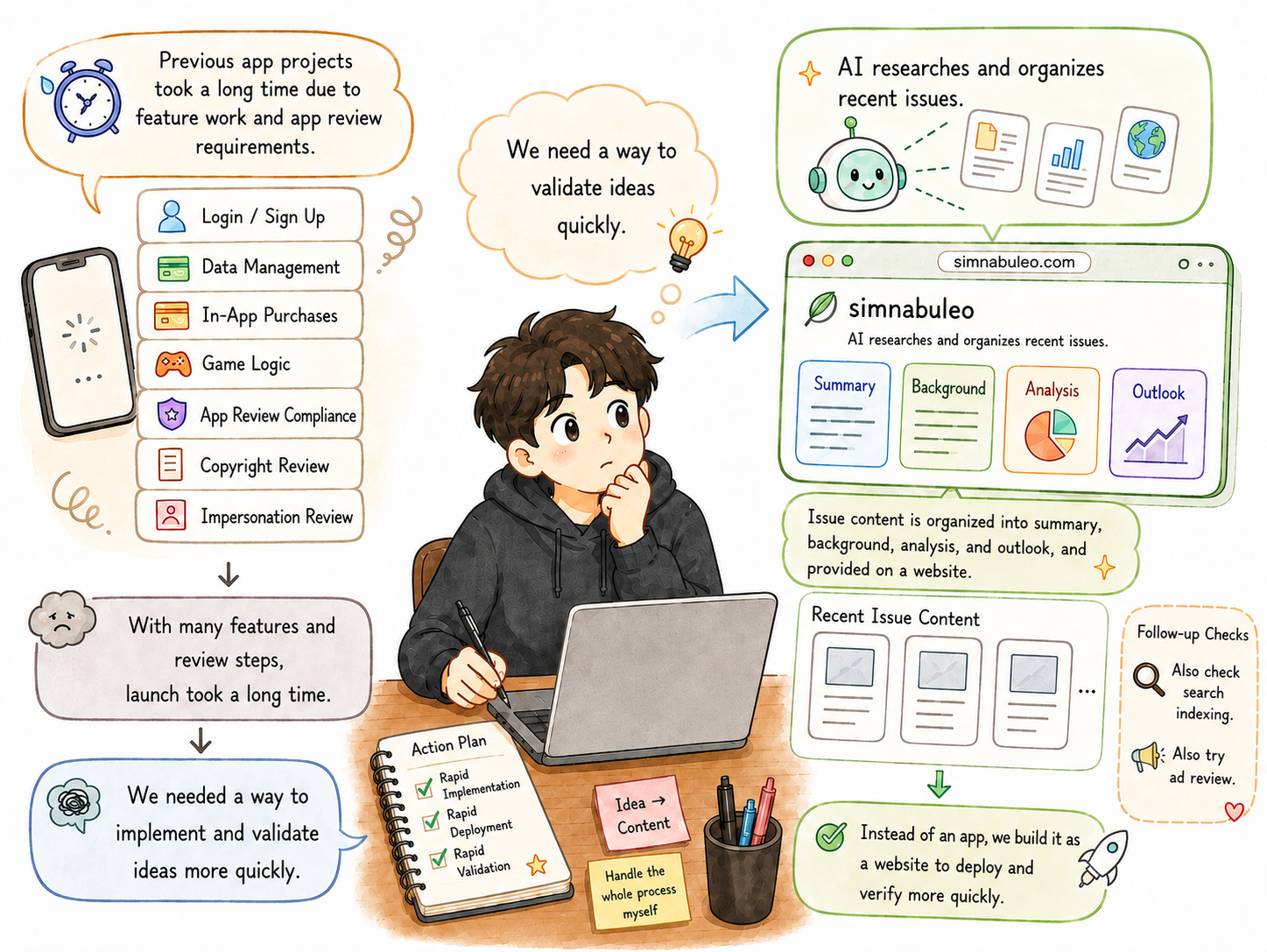
I decided that I needed a web-based project that could be deployed and tested more quickly than an app, because the review process for app release, copyright, and impersonation checks had become longer in previous projects.
What I wanted to validate through this project was website development using Claude Code, the possibility of search visibility for an AI-based content website, and attempts at ad monetization.
Main image
Participants
Name
Organization
Role
JaeKyeong Sim
—
Developer
Period
2026-02-16 – 2026-02-28
Technologies Used
SvelteUsed to build the website screens, implement components, and structure website routing
SvelteKitUsed to build the website screens, implement components, and structure website routing
Tailwind CSSUsed for responsive UI and page styling
The previous project, "Illuminate the Dark Dungeon", took longer than expected because it included login, data management, in-app purchases, game logic, and app release review responses. In particular, the Google Play Store release process involved continued reviews related to impersonation and copyright, which made me feel that continuing to build only apps was not the best way to quickly implement and validate ideas.
So I decided to make the next project a website rather than a mobile app. A website can be accessed without installation, and it can be checked immediately after deployment without app store review. In addition, because it can be registered with Google Search Console to check indexing and exposure, I judged it to be more suitable for quickly building a product and testing user response within a short period.
Another focus was AI-generated content and ad monetization. With AI, content that researches and summarizes news or issues can be produced relatively quickly. However, search traffic or ad revenue does not automatically happen just because AI generates content. Therefore, in this project, I wanted to build an actual AI-based content website and check what conditions and limitations appear during search indexing and ad review.
For the development tool, I used Claude Code. Previously, I had tried vibe coding mainly with Cursor, but when sessions became longer or the work scope became broader, the result often became unstable. So I wanted to see whether using Claude Code subagents to divide different types of work, such as planning, implementation, UI, and content processing, would lead to more stable results. [Anthropic - Claude Code Docs, Subagents]
Goal
Reason
Switch from an app to a website
To deploy and validate quickly without app review
Use Claude Code
To apply a role-based vibe coding workflow using Claude Code subagents to real web development and check whether the results become more stable
Check search indexing
To check the possibility of search visibility through Google Search Console and sitemap submission
Attempt ad monetization
To check the review possibility of ad networks such as Google AdSense and Ezoic
Background and Goal
Key Features
AI-based issue content
Provides content on recent issues in the form of summaries, background, analysis, and outlooks, while using AI to automate the content creation process
Content list
Organizes multiple issue-based articles in a list so users can easily browse the latest content
Content detail pages
Provides analysis of each issue as an independent page so users can explore one topic in depth
Category structure
Classifies content by topics such as economy, society, technology, science, and culture to support topic-based browsing
Responsive UI
Structures the interface so the website can be used naturally on both mobile and desktop environments
Search function
Provides search functionality so users can find content based on the issue or keyword they want
Multilingual support
Builds a structure that can provide content in multiple languages for global users
Development
Setting the Development Goal
The goal of this project was not to build a feature-heavy web service, but to create an AI-based issue content website within a short period and validate it in a real web environment.
I excluded features that would expand the implementation scope, such as sign-up and payment. Instead, I focused on a basic content delivery structure that allowed users to browse content and read individual issues.
During development, I used Claude Code for vibe coding. I wanted to check whether a workflow that divides roles using subagents could also be applied stably to real web development.
After deployment, I checked whether content pages could be indexed by search engines through Google Search Console and a sitemap. I also attempted Google AdSense and Ezoic reviews to see whether an AI-based content website could become a target for ad monetization.
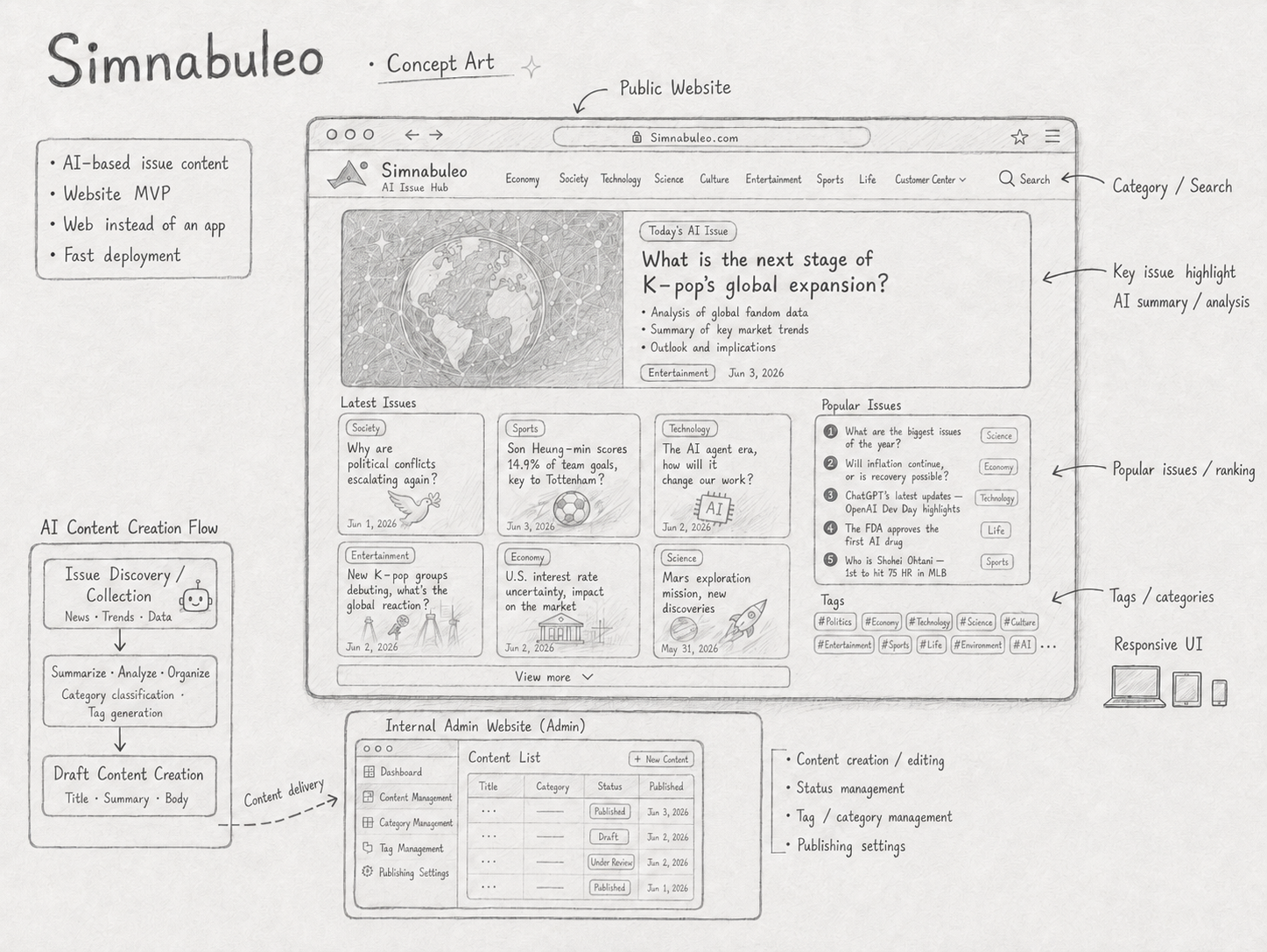
Concept for simnabuleo
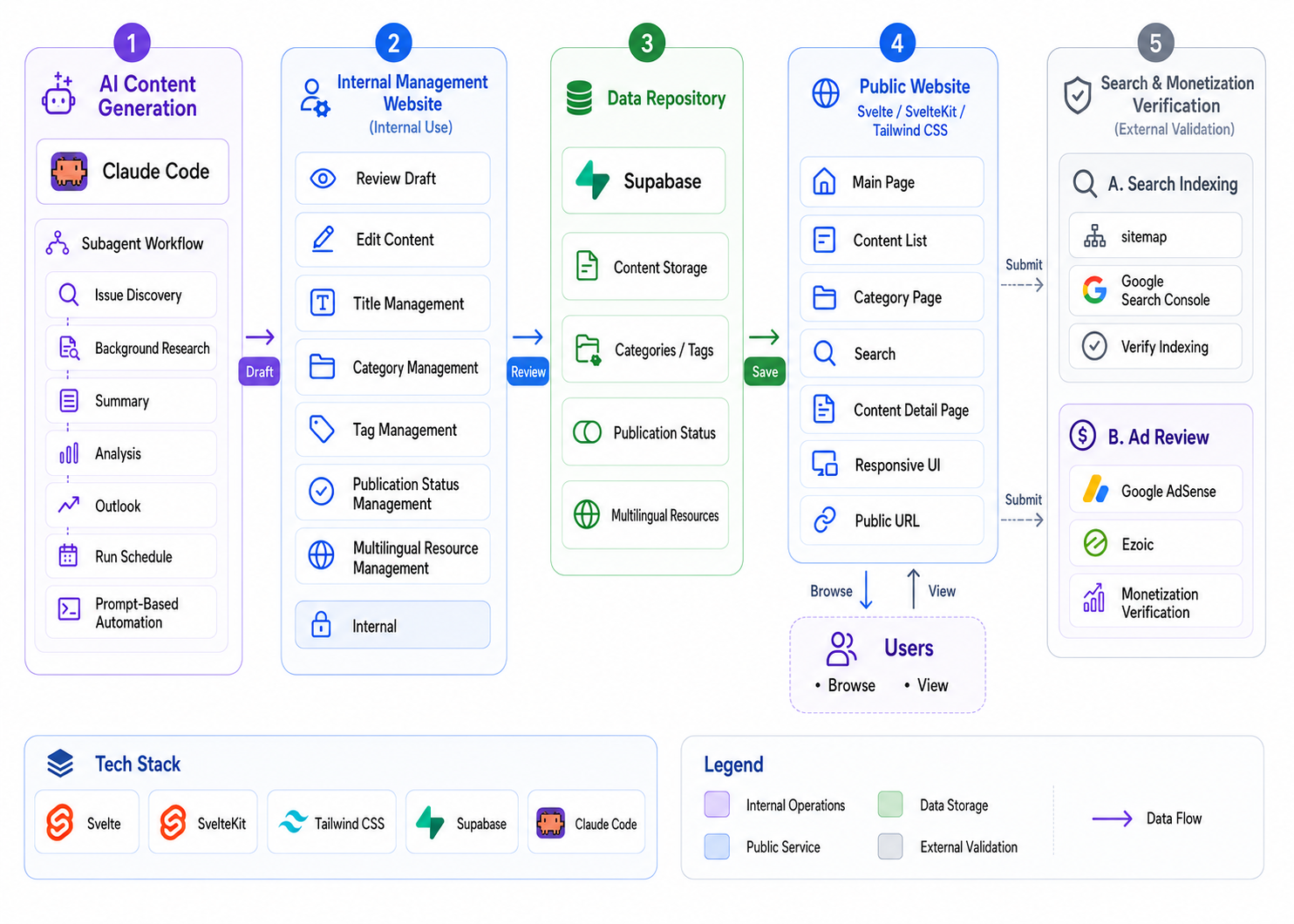
System Architecture
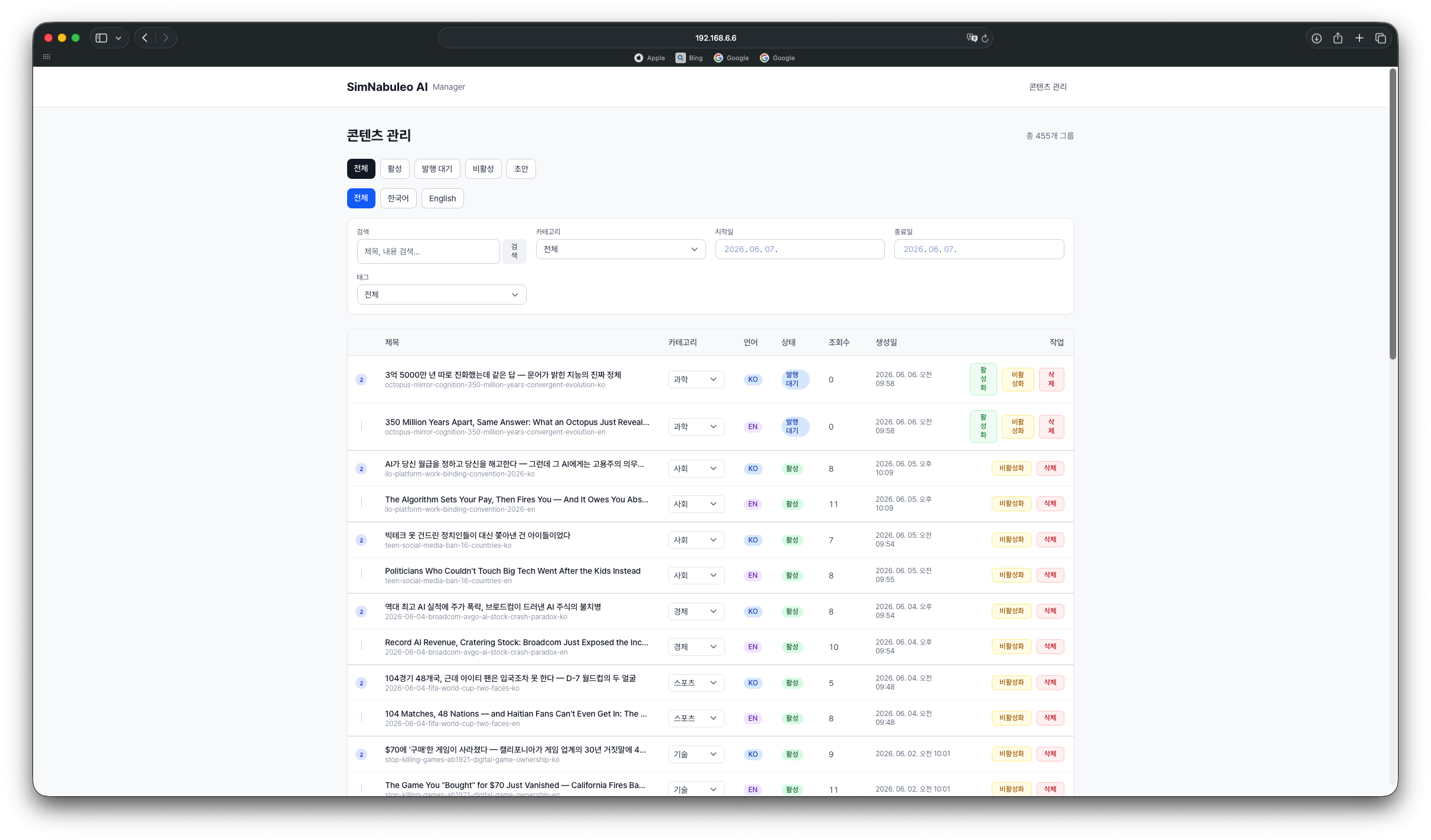
"simnabuleo" was structured by separating the public website accessed by users from an internal admin website used to write and manage content. The public website is where users browse and read issue-based content, while the internal admin website is used as a management tool to generate, organize, and reflect AI-based content on the public site.
Component
Role
Public website
A website where users access and read AI-based issue content
Internal content management website
A content writing, editing, and management website accessible only from the internal network
AI content generation
Creates content drafts in the form of summaries, background, analysis, and outlooks based on recent issues
Content management module
Manages the title, body, category, tags, and publication status of generated content
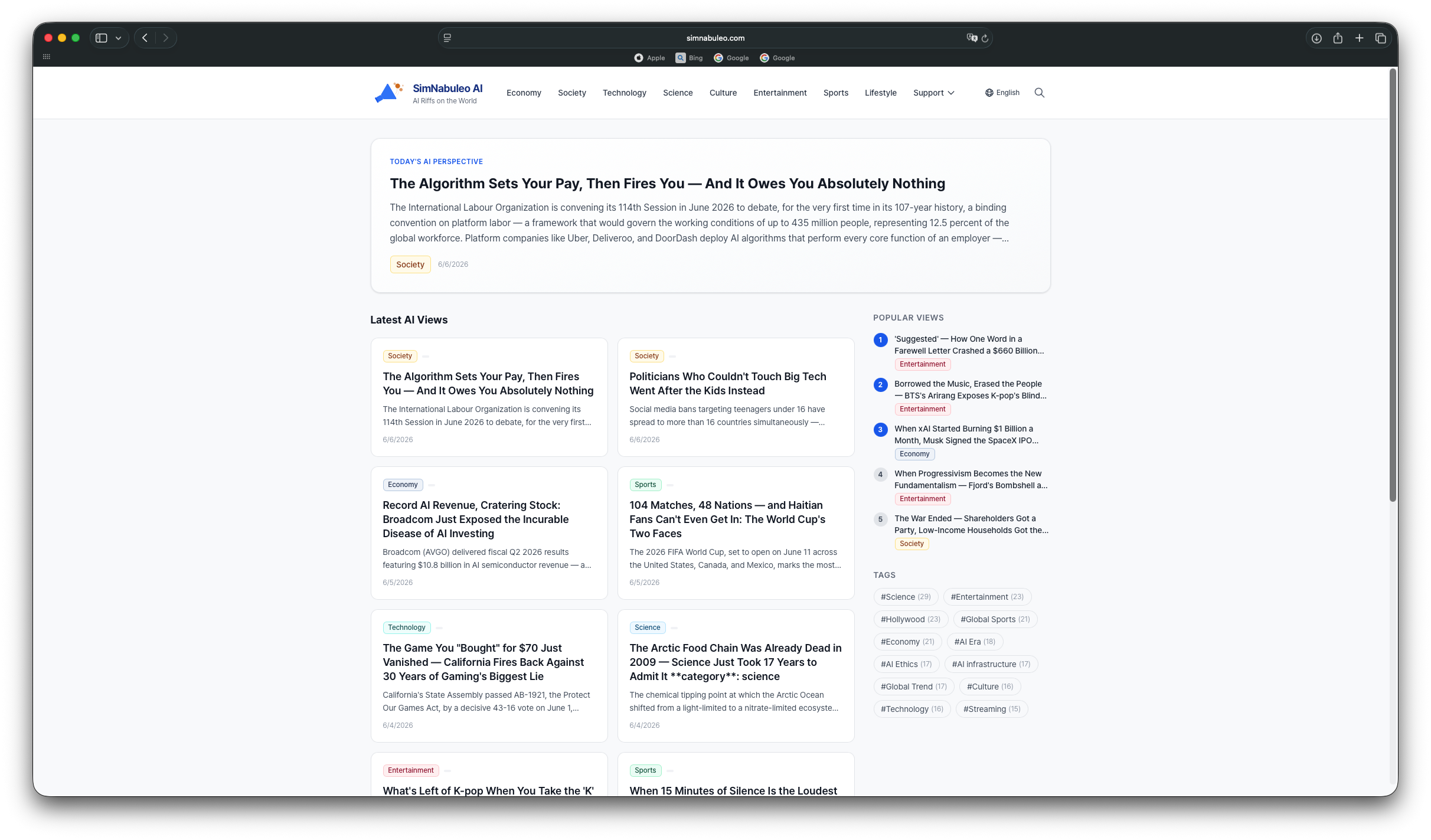
Main page
The entry page of the public website that displays the latest and featured content
Content list page
Displays multiple issue-based articles in list form so users can browse them
Category / tag structure
Classifies content by topics such as economy, society, technology, and science, and supports discovery of related content
Content detail page
Provides each issue's summary, background, analysis, and outlook through an independent URL
Search function
Helps users find content based on the issue or keyword they want
Sitemap generation structure
Reflects published content URLs in the sitemap so search engines can discover them
Multilingual resources
Provides and manages content for each supported language
System Architecture Diagram
Core Implementation Flow
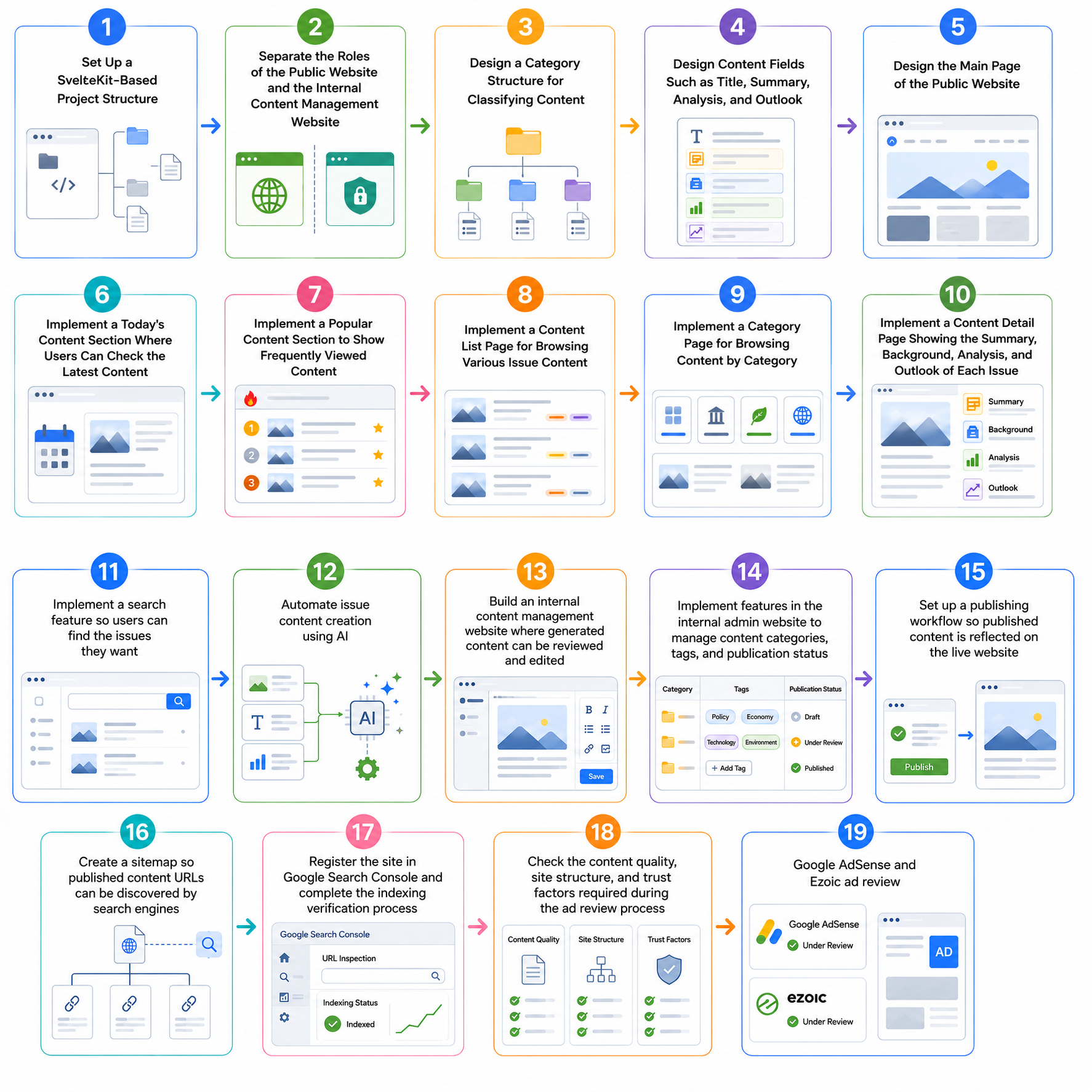
Implementation Flow
Content Generation and Publishing Structure
The content generation system of "simnabuleo" was built around Claude Code. Instead of simply asking one AI to write an article, I divided the roles required for content generation and assigned subagents to each role, so the system worked like a team of AI agents specialized in content creation.
This agent team divided work into roles such as finding recent issues, researching the background of those issues, summarizing key points, and organizing their meaning and outlook. Through this, I aimed to keep the flow and quality of the content more stable than generating everything at once with a single prompt.
The content automation was implemented using an open-source plugin that can automatically run and schedule Claude Code. I did not create a new automation logic through separate code. Instead, I configured Claude Code to run at scheduled times and set up the prompts and workflows it would use when running.
In other words, the content generation structure of "simnabuleo" was closer to prompt-based automation than code-based automation. With predefined prompts and subagent role structures, issue content was generated, then reviewed and edited in the internal content management website before being published to the public website.
Home page
Admin Page
Search Indexing Response
After publishing AI content on the public website, "simnabuleo" configured a sitemap so each content page could be discovered by search engines. Then I registered the site in Google Search Console and submitted the sitemap to check whether the published content URLs were included as indexing targets.
Through this process, I confirmed that simply deploying a website does not guarantee search visibility. The website needed a structure that allowed search engines to discover pages, and it was important to check whether each piece of content was provided through an independent URL, whether it was correctly reflected in the sitemap, and whether its indexing status could be checked in Search Console.
Therefore, the focus of this section is not to emphasize search traffic performance, but to show that I built a structure that allowed search engines to recognize an AI-content website and verified the actual indexing process.
Ad Monetization Validation
"simnabuleo" attempted reviews by Google AdSense and Ezoic to check whether an AI-based content website could become eligible for ad network review. The purpose was not to generate actual revenue, but to verify whether the public website could be expanded into an ad monetization structure.
For this, I reviewed elements required for ad review, such as content detail pages, category structure, basic site information, and public URL structure. Simply generating content automatically and publishing it on a website was not enough. I learned that readable content quality and site credibility were also necessary.
As a result, this project progressed to the stage of attempting ad monetization. I learned that turning an AI-content website into a monetizable product requires not only content production automation but also content quality control and site credibility.
How Claude Code Was Used
In this project, I used Claude Code not merely as a code generation tool, but as a tool for dividing and managing the web development workflow. In my previous Cursor-based vibe coding attempts, when the work scope became broader, planning, UI, content structure, and code modifications were mixed into one flow, which sometimes made the result unstable.
To reduce this issue, I used Claude Code subagents in "simnabuleo". I separated tasks with different characteristics, such as planning, implementation, UI composition, and content processing, by role and had each task reviewed from an independent perspective. This helped me organize public website development, internal content management website construction, and the content generation automation flow step by step instead of handling everything at once.
In particular, for the content generation area, I built a team of AI agents specialized in content creation inside Claude Code. Each subagent was assigned a role such as issue selection, research, or article writing, and I used an open-source plugin that automatically runs and schedules Claude Code so predefined prompts could be executed repeatedly. Rather than writing separate automation code, the key experiment of this project was automating the content generation flow through prompts and role structures.
Achievements
Vibe coding using Claude Code subagents
Success
Checking search visibility through site registration in Google Search Console
Failure
Adding ads such as Google AdSense and Ezoic for monetization
Failure
"simnabuleo" was a project in which I implemented an AI-based issue content website in MVP form within about two weeks and deployed it as an accessible website. I created content lists, categories, and detail pages so users could browse multiple issue-based articles, and I was able to test it quickly in a web environment without app store review.
After deployment, I registered the site in Google Search Console and submitted a sitemap to check whether the published content pages could be discovered and indexed by search engines. The pages that were initially indexed gradually stopped being indexed. Through this, I confirmed that building a website and generating search traffic are separate problems, and that both a technical structure for indexing and content quality need to be considered.
In terms of ad monetization, I attempted Google AdSense and Ezoic reviews. Through this process, I confirmed that an AI-content website cannot succeed simply by generating a large amount of content. Site credibility, originality of content, and value provided to users are also necessary. Google also explains that it does not prohibit AI-generated content itself, but places importance on whether the content is helpful, reliable, and people-first [Google Search Central Blog - Google Search's guidance about AI, generated content]..
The result of this project was not successful ad monetization, but the experience of actually building an AI-based content website and directly checking the conditions required in the search indexing and ad review process.
Lessons Learned from the Project
First, I confirmed that websites are suitable for faster validation than apps. Apps require installation and review processes, but websites can be accessed immediately after deployment, and changes can be reflected quickly.
Second, vibe coding using Claude Code subagents helped produce more stable results than before. I was able to divide work by roles such as planning, implementation, UI, and content processing, and I confirmed that this approach was also effective for web development.
Third, nevertheless, the limitations of vibe coding still existed. As the project scope grew, there were cases where requirements were not reflected accurately in one attempt. In the end, structural judgment and validation of the final output had to remain the developer’s responsibility.
Fourth, I learned that an AI-content website is not completed by content generation alone. To consider search indexing and ad monetization, technical structures such as independent URLs, a sitemap, and Search Console must be considered together with content credibility and user value.